
 English
 Español
 Pусский
 Français
quadruped robot for education and research
Quadruped Robot for Education and Research Quadruped robots, inspired by the locomotion of four-legged animals, have gained significant attention in education and research due to their versatility, dynamic capabilities, and potential applications in various fields. These robots serve as excellent platforms for teaching robotics, control systems, artificial intelligence (AI), and mechanical design, while also enabling advanced research in areas like autonomous navigation, adaptive locomotion, and human-robot interaction. Educational Applications For students and educators, quadruped robots provide a hands-on learning experience in robotics and engineering. Their multi-jointed legs and complex gait patterns introduce fundamental concepts such as kinematics, dynamics, and feedback control. Students can experiment with inverse kinematics to plan movements or implement PID controllers to stabilize the robot’s posture. Additionally, programming quadruped robots helps develop skills in Python, C++, or ROS (Robot Operating System), which are essential for modern robotics. Many educational quadruped robots are designed with modularity in mind, allowing customization of hardware (e.g., actuators, sensors) and software (e.g., gait algorithms, machine learning models). This flexibility encourages creativity, enabling students to explore different locomotion strategies, obstacle avoidance, or even swarm robotics. Research Applications In research, quadruped robots are used to study bio-inspired locomotion, reinforcement learning, and real-world adaptability. Researchers leverage these robots to test advanced control algorithms that enable stable walking, running, or climbing over uneven terrain. Machine learning techniques, such as deep reinforcement learning, are often applied to train quadruped robots to autonomously adapt to dynamic environments without explicit programming. Another key research area is sensor integration, where quadruped robots are equipped with LiDAR, cameras, or IMUs (Inertial Measurement Units) to enhance perception and decision-making. This enables applications in search and rescue, environmental monitoring, and industrial inspection. Additionally, collaborative research between robotics and biomechanics helps scientists better understand animal locomotion and apply those principles to improve robotic designs. Conclusion Quadruped robots are powerful tools that bridge education and cutting-edge research. Their ability to mimic biological movement while incorporating modern AI and control systems makes them ideal for training future roboticists and advancing autonomous robotics. As technology progresses, these robots will continue to play a crucial role in shaping the next generation of intelligent machines.
نتاج
تصنيف:
-
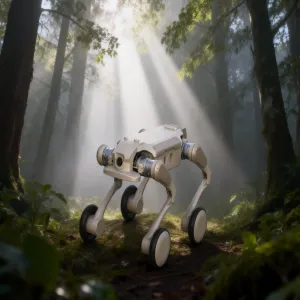
Wheeled Medium-Sized Quadruped Robot – Real-Time Data Collection and 3D Mapping Specialist
تصنيفها: Veneer Dryerالمشاهدات: 30عدد:وقت الإصدار: 2025-12-26 16:47:10Wheeled Medium-Sized Quadruped Robot – Real-Time Data Collection and 3D Mapping Specialist
أخبار
تصنيف:
-
[Company News]Autonomous Quadruped Robot Systems by Xinmite: Intelligent R...
2026-01-09 17:58:21
حالة
تصنيف:
لا توجد نتائج بحث!
فيديو
تصنيف:
لا توجد نتائج بحث!
تحميل
تصنيف:
لا توجد نتائج بحث!
تجنيد
تصنيف:
لا توجد نتائج بحث!
المنتجات الموصى بها
لا توجد نتائج بحث!




 هاتف
هاتف